AI Foundry
A live AI learning platform built around one clear loop: learn, test, build, and show the work.
This case study is about turning AI education into a guided product journey: roadmap structure, short lessons, quizzes, portfolio missions, and progress states that help learners know what to do next.
Role
Founder and Senior Product Engineer - designed and built the learning platform, curriculum experience, project system, progress model, and public product interface for AI learners.
Domain
AI education and portfolio learning
Proof Level
Live public product
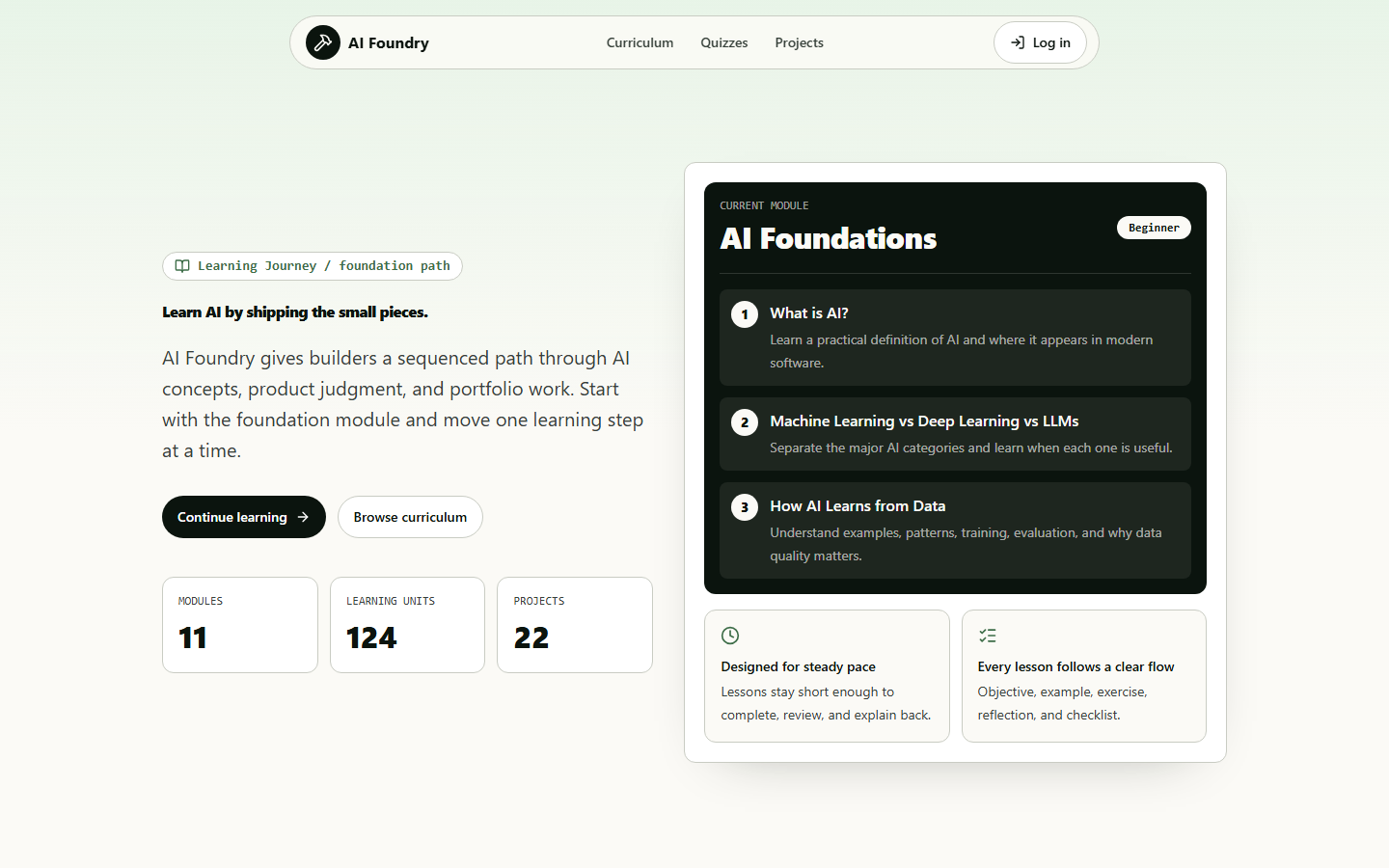
Launch Proof
Live public product
The live product can be reviewed as a working learning path, with curriculum structure, quizzes, missions, and progress-oriented screens visible in production.
Curriculum Evidence
Roadmap, quizzes, and build missions
Public visual evidence is included for this project. The screenshots should be read as evidence of the learning loop, not as a claim about learner outcomes.
Learning Loop
From scattered AI study to portfolio-ready building.
The case study follows the learner from roadmap clarity into lessons, checks, missions, and submission prompts.
Learner Gap
AI learners often collect tutorials without knowing what to study next, how to apply it, or how to prove they can build something useful.
Curriculum Shape
The public product is organized as a step-by-step learning path with modules, lessons, quizzes, build missions, progress states, and portfolio submission prompts.
Product Ownership
Founder and Senior Product Engineer - designed and built the learning platform, curriculum experience, project system, progress model, and public product interface for AI learners.
Learning Response
I shaped the experience around a simple promise: learn a concept, test understanding, then build something concrete enough to show.
Journey Structure
The product is structured around the learner journey: roadmap, lesson, quiz, mission, progress, and submission. Technical choices support that sequence rather than becoming the story.
Roadmap Inventory
The pieces that make progress visible.
Each feature supports the same loop: learn a concept, prove understanding, then build something that can sit in a portfolio.
0111-stage AI learning roadmap
02124 structured learning units
0322 portfolio build missions
04Knowledge trials and stage-gated quizzes
05XP, streak, and progress-oriented learning states
06Project submission and portfolio tracking surfaces
Curriculum Choices
How structure beats another pile of tutorials.
The important decisions are about sequence, proof of work, and avoiding feature noise around the learner.
Make progression obvious
AI learners need to know exactly what to study next, so the product emphasizes stage order, locked states, current lesson guidance, and clear next actions.
Tradeoff: A sequenced path gives learners structure, while intentionally limiting random jumping between advanced topics.
Connect learning to proof of work
The platform pairs lessons and quizzes with build missions so learners can create portfolio evidence instead of only consuming content.
Tradeoff: This requires more product logic around projects, completion states, and submission flows, but makes the learning outcome more practical.
Launch Notes
What the first public version proves.
The page stays with what is verifiable: a launched learning product and the next metrics still to gather.
Launch Evidence
Launched a live learning product with a complete curriculum path, quizzes, build missions, and a portfolio-progress model for AI learners.
Learning Insight
Learning products work better when the next action is obvious and every lesson connects to a visible outcome.
Next Learning Signals
Continue expanding account-based tracking, portfolio submissions, curriculum depth, and learner outcome metrics.
Related work
Nearby product problems.
Other work with a related domain, workflow, or product category.