PayCita
A back-office operations platform where reliability matters across HR, finance, procurement, and admin flows.
The case study focuses on shared workflow reliability: protecting existing screens, consuming API endpoints carefully, and keeping loading, empty, error, and success states understandable for operational users.
Role
Senior Engineer - reviewed code, integrated and consumed API endpoints, strengthened frontend reliability, and helped ensure the platform worked optimally without breaking existing workflows.
Domain
ERP and internal operations
Proof Level
Public case study
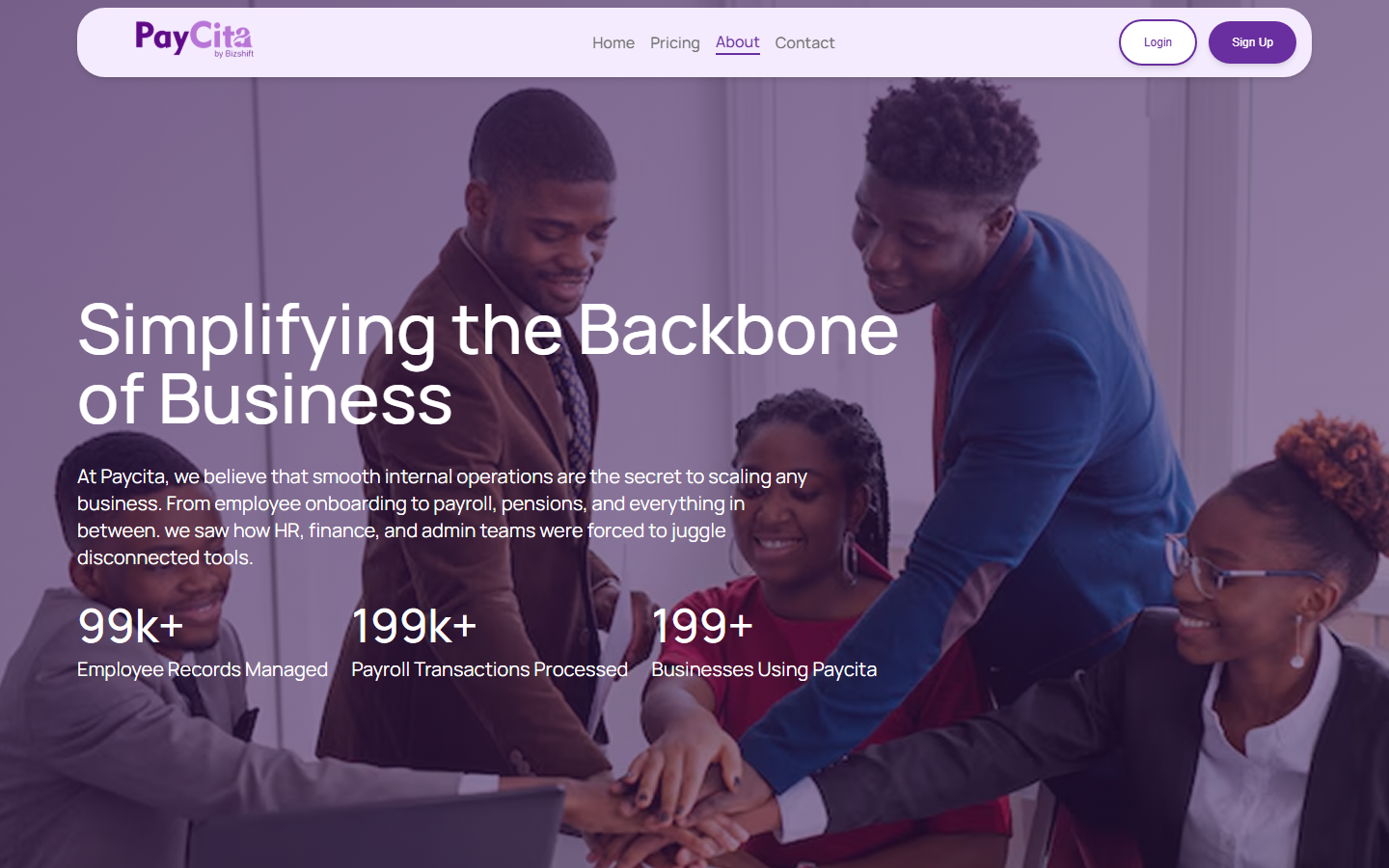
Public Case Proof
Public case study
The public company site provides external context, while this detail page focuses on the operational product work that can be described without internal metrics.
Operations Evidence
Shared back-office workflows
Public visual evidence is included for this project. The strongest proof is the product area: HR, finance, procurement, payments, and admin work living in a shared system.
Operations Context
Back-office work that depends on predictable shared flows.
The case study frames PayCita as reliability work across recurring business operations rather than a generic dashboard build.
Operational Fragmentation
Back-office teams lose time and accuracy when salaries, leave, procurement, payments, approvals, finance, and admin work sit in separate tools.
Back-office Context
The product serves recurring business operations, so the experience needed to feel dependable, predictable, and hard to break.
Senior Engineering Contribution
Senior Engineer - reviewed code, integrated and consumed API endpoints, strengthened frontend reliability, and helped ensure the platform worked optimally without breaking existing workflows.
Connected Workflow Response
The product experience connects related operational tasks so teams can move through HR, finance, procurement, and payment workflows from a shared system.
Operations Shape
The public story is organized around operational areas, user tasks, and reliability rather than stack details.
Operations Workspace
The connected tasks the product had to keep steady.
Features are grouped around the repeatable work teams come back to: salaries, leave, procurement, payments, finance, and admin tasks.
01HR, salary, leave, and finance tools
02Procurement and payment-related operational flows
03Administrative task surfaces
04Clear loading, empty, error, and success states
05Shared patterns for recurring back-office tasks
Reliability Choices
Protecting existing workflows while new work ships.
The key decisions are about regression risk, API states, and clear feedback across connected screens.
Protect existing workflows while extending the platform
As a senior engineer, code review and careful API integration helped reduce regressions across interconnected business flows.
Tradeoff: This requires slower, more deliberate delivery around shared states, validation, and edge cases.
Keep API contracts visible in the UI
Operational users need clear loading, error, empty, and success states when screens depend on backend endpoints.
Tradeoff: More attention goes into state handling and error recovery, but the product becomes easier to trust.
Delivery Notes
Reliability work with public proof still limited.
The page explains the type of contribution without inventing internal adoption, time-saving, or business metrics.
Reliability Contribution
Helped strengthen a business-critical operations product by improving reliability across connected screens and protecting existing user workflows while new work shipped.
Operations Lesson
Operations products need boring reliability: clear states, predictable flows, and careful changes because many teams depend on the same shared system.
Evidence to Add
Add verified screenshots, dates, and measurable workflow outcomes when available.