WishNGrant
A live wish-granting startup where trust, fee clarity, and contribution flow are the product.
This page follows the marketplace loop from a person explaining a wish to a supporter deciding whether to contribute, with the public launch separated from the validation metrics still to prove.
Role
Founder and Senior Product Engineer - shaped the product, built the public platform, prepared payment flows, and launched the first version.
Domain
Wish granting and community giving
Proof Level
Live public product
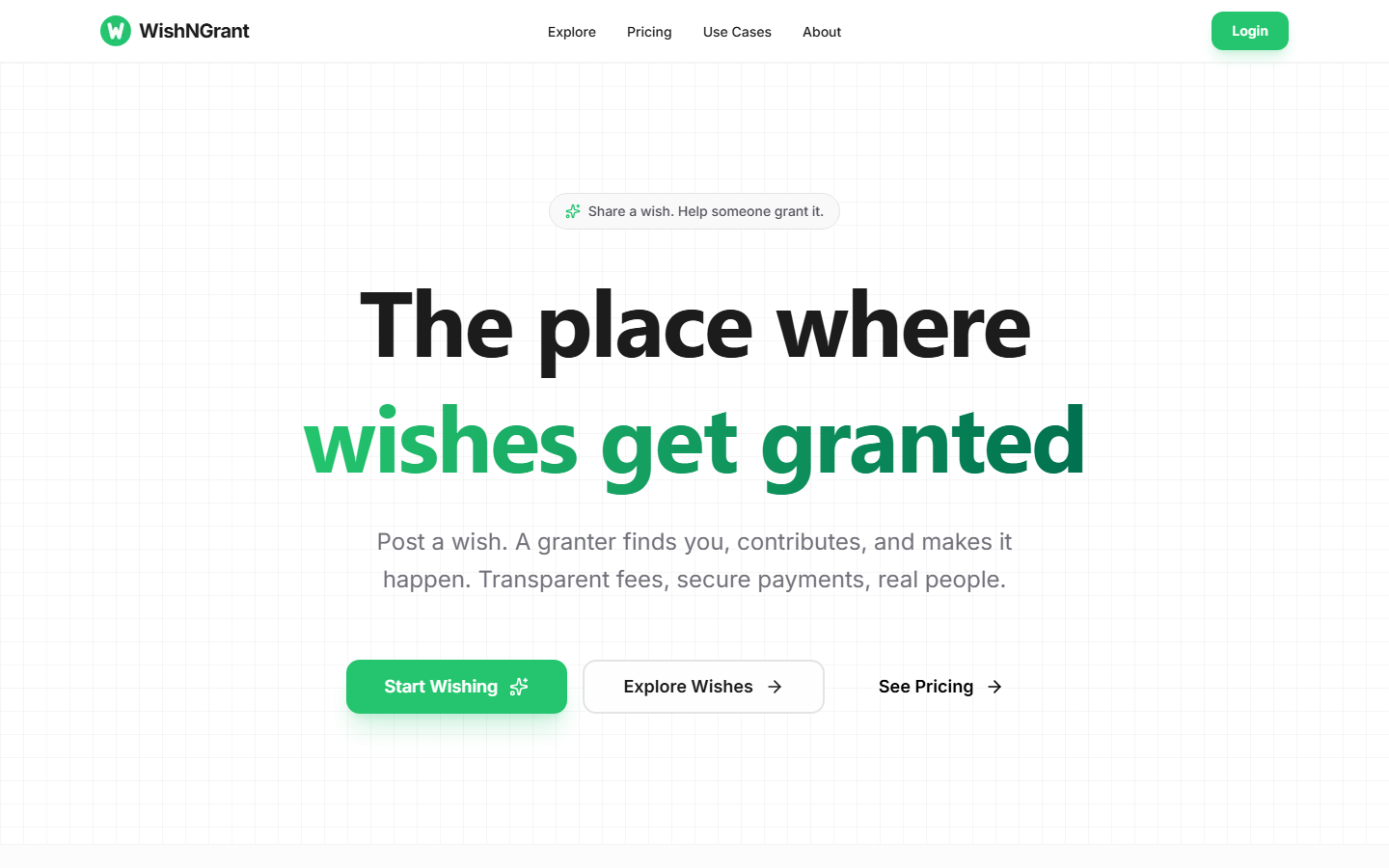
Startup Proof
Live public product
The public product is live, so the page can point to a real launch while keeping growth, contribution, and conversion claims tied to future validation.
Trust Evidence
Wishes, fees, payments, and updates
Public visual evidence is included for this project. The visible proof is the trust loop: wish context, supporter review, fee clarity, and progress communication.
Trust Loop
Turning generosity into a product people can understand.
The case study follows both sides of the marketplace: a person explaining a wish and a supporter deciding whether to contribute.
Trust Problem
People asking for help need a way to explain the wish clearly, while supporters need enough context and trust signals to feel comfortable contributing.
Marketplace Context
The product has to balance generosity with trust: wish details, payment clarity, updates, fraud prevention, and compliance language all affect whether people feel safe using it.
Founder Ownership
Founder and Senior Product Engineer - shaped the product, built the public platform, prepared payment flows, and launched the first version.
Wish-to-Grant Loop
I built the product around a simple loop: create a wish, explain the need, let supporters review context, contribute securely, and follow progress through updates.
Trust Architecture
The product experience is organized around wish pages, discovery, contribution, fee clarity, trust content, payment readiness, and update flows.
Granting Flow
The surfaces that reduce doubt before payment.
Each feature exists to make a wish easier to understand, safer to support, and clearer to follow after contribution.
01Wish creation and discovery flows
02Grantor-facing contribution experience
03Transparent checkout and fee breakdown
04Trust signals, profiles, updates, and progress surfaces
05Public launch, deployment, and production readiness
Trust Choices
Where product clarity carries the marketplace.
The tradeoffs center on trust, payment readiness, safety language, and shipping a founder-led first version.
Build trust into the core workflow
Wish-granting depends on confidence, so wish details, fees, payment checks, updates, and safety content needed to be visible throughout the product.
Tradeoff: This adds more product surface area, but it makes the platform more credible for both wish creators and grantors.
Ship as a real startup product
The platform needed production deployment, public pages, pricing clarity, payment readiness, and user-facing flows rather than a prototype-only implementation.
Tradeoff: Founder-led shipping requires balancing speed with reliability, compliance messaging, and responsible trust-building.
Founder Notes
A public launch with validation still ahead.
The page is explicit about what is live now and what still needs market, trust, and conversion evidence.
Launch Evidence
Took the product from idea to public launch, creating a live startup around transparent wish granting and community support.
Marketplace Lesson
Trust-based consumer products need more than a nice interface. The copy, economics, safety language, and payment path all have to reduce doubt.
Validation Signals
Continue validating user acquisition, grantor trust, wish quality, payment conversion, and operational workflows as the platform grows.
Related work
Other founder-led marketplace and workflow experiments.
Nearby projects that also deal with trust, matching, operations, or early-stage product validation.